I neglected to post last week, so we’ll get two today.
My husband and I participated in the Bridge of Lions 5k last weekend. Picturesque start at the Castillo de San Marco (the oldest masonry fort in the continental United States, built beginning in 1672), then crossing the Bridge of Lions, then continuing through neighborhoods in St. Augustine.
Wikipedia says:
“The Bridge of Lions is a double-leaf bascule bridge that spans the Intracoastal Waterway in St. Augustine, Florida. A part of State Road A1A, it connects downtown St. Augustine to Anastasia Island. A pair of Medici lions made of marble guard the bridge, begun in 1925 and completed in 1927 across Matanzas Bay.
From its earliest days, it was hailed as "The Most Beautiful Bridge in Dixie." It has long been a symbol of the nation's oldest city.
It gets its name from two Carrara marble Medici lions statues that are copies of those found in the Loggia dei Lanzi in Florence, Italy. The statues were a gift of Dr. Andrew Anderson (1839–1924), the builder of the Markland House, who spent the last decade of his life putting works of art in public places in the Ancient City. The statues were his last gift, and he did not live long enough to see them installed. He had them made by the Romanelli Studios in Florence, Italy, which a decade earlier had provided him with smaller versions which he displayed on the front steps at Markland. The lions are a symbol of the Spanish royal family.”
A week or so before the race, St. Augustine unveiled a set of two lions on the other side of the bridge. I was eager to see them, but was disappointed. For one, they are positioned facing the bridge, a short distance from the base, so they don’t offer the same ‘guarding the bridge’ look that the original lions present. Secondly, we are told they are made of granite instead of marble. That is obvious, but to me they look more like poured concrete. Can you cast granite? They are grey and monotone and don’t have the same detail. Oh well, I guess it is better than no lions, but I’d have tried harder for a more art-like look rather than the more ‘pedestrian’ result.
Just my opinion.
Sunday, July 26, 2015
Sunday, July 12, 2015
Raptors
Many species of birds may be considered partly or exclusively predatory. However, in ornithology, the term "bird of prey," or "raptor" applies only to birds that have very good eyesight for finding food, strong feet for holding food, and a strong curved beak for tearing flesh. Most birds of prey also have strong curved talons for catching or killing prey. Birds of prey generally prey on vertebrates, which are usually quite large relative to the size of the bird. Most also eat carrion, at least occasionally, and vultures and condors eat carrion as their main food source. Many raptor species are considered apex predators.
I doubt that there are *more* birds of prey in Florida, but I certainly see more. I've only spotted owls up north, though I have heard them here. Up north, vultures are migratory birds - we'd see them ominously flying in large groups overhead during the Halloween parade at the grade school, and the first one back were the true harbingers of spring (some robins north stay year 'round nowadays). Here in the South we have two types of vulture - turkey and black. The head of a turkey vulture is red, while that of the black is, well, black. The position of the grey wing feathers helps you tell them apart in flight.
I was surprised at how many bald eagles I've seen. I certainly know they are primarily fishing birds, and of course I'm by a coast, but except for the occasional eagle seen along the Great Lakes or the Mississippi River, my mind has come to accept the media connection between bald eagles and snow-capped mountains.
Hawks are a bit different here, and there are LOTS of ospreys. Again, I've seen one before here and there, but a good number hang around one of the longest bridges over the St. Johns River, so you can nearly always see one when you cross. Just this Friday I saw one flying with a large fish in its talons. Very cool.
But the coolest raptor here is the Swallow-Tailed Kite. It winters in Brazil and returns to Florida each spring to nest. They can be seen, usually soaring overhead, between March and August. A stunning and distinctive bird.
To me, more than beaches and palm trees, the best part of Florida is the birds.
I doubt that there are *more* birds of prey in Florida, but I certainly see more. I've only spotted owls up north, though I have heard them here. Up north, vultures are migratory birds - we'd see them ominously flying in large groups overhead during the Halloween parade at the grade school, and the first one back were the true harbingers of spring (some robins north stay year 'round nowadays). Here in the South we have two types of vulture - turkey and black. The head of a turkey vulture is red, while that of the black is, well, black. The position of the grey wing feathers helps you tell them apart in flight.
I was surprised at how many bald eagles I've seen. I certainly know they are primarily fishing birds, and of course I'm by a coast, but except for the occasional eagle seen along the Great Lakes or the Mississippi River, my mind has come to accept the media connection between bald eagles and snow-capped mountains.
Hawks are a bit different here, and there are LOTS of ospreys. Again, I've seen one before here and there, but a good number hang around one of the longest bridges over the St. Johns River, so you can nearly always see one when you cross. Just this Friday I saw one flying with a large fish in its talons. Very cool.
But the coolest raptor here is the Swallow-Tailed Kite. It winters in Brazil and returns to Florida each spring to nest. They can be seen, usually soaring overhead, between March and August. A stunning and distinctive bird.
To me, more than beaches and palm trees, the best part of Florida is the birds.
Sunday, July 5, 2015
Refusing Service
I have my own religious beliefs, and while I may *wish* that others were of a similar mindset, I would never think to impose my beliefs on others, particularly if the other person has no expectation of a confrontation. If I wander into someone else's church, I am fair game for persuasive discussion. What I do not understand is why normally sensible people think they can bully someone into changing their viewpoint. Even if the other person caved and agreed, everyone knows that is not from the heart - the change is not sincere. This goes for the (so-called) Islamic State, but also closer to home.
I read a news report "Kentucky Clerk Sued Over Marriage Licenses -
Rowan County Clerk Kim Davis states that her Christian beliefs prevented her from complying with the decision, so she opted to not issue any more licenses to couples regardless of their orientation."
This goes far beyond simply making a point If gay marriage is such a major insult to your belief system, find another job. Will you refuse to update civil records (or whatever else county clerks do) if one partner in a same-sex marriage changes the last name to that of the other partner? It seems to me that you can no longer do your job, so move on.
This line of thinking can spread beyond a county clerk, or even beyond the marriage issue. There are other religious tenets regarding marriage.
So if I am an Orthodox Jew or observant Catholic or Muslim, I can deny marriage licenses where one party is Jewish/Catholic/Muslim and the other is not? Not necessarily forbidden (the Bible does not specifically *forbid* same-sex marriage either) but frowned upon by those religions.
Divorce and remarriage without an annulment is against Catholic Canon Law, so I won't issue licenses to anyone who is divorced.
My church teaches that the purpose of marriage is procreation, therefore I won't issue a marriage license to the elderly.
I am a grocery store cashier, and I won't sell you bacon because my religion forbids pork.
I am a grocery store cashier, and I won't sell you coffee because I am Mormon.
You'll need to ask another waitress for a glass of wine because alcohol is evil and I won't serve it.
This can go on and on. If your job is a publicly-paid position, such as a county clerk, then you don't get to choose which laws you will comply with or which job duties you will perform. If you are in a job which serves the public, then completing the duties of the job is a requirement.
Now, churches are a different matter altogether. Churches have always restricted their sacraments to their members in good standing. Religious institutions should be able to decide how to apply their tenets to their members.
Private businesses are where things get tricky. I don't have a problem with the Hobby Lobby decision IF:
This type of service refusal, in the name of religion, is just nasty and in conflict with Christian teaching, and probably everyone else's as well. People can't be bullied into seeing another point of view.
I read a news report "Kentucky Clerk Sued Over Marriage Licenses -
Rowan County Clerk Kim Davis states that her Christian beliefs prevented her from complying with the decision, so she opted to not issue any more licenses to couples regardless of their orientation."
This goes far beyond simply making a point If gay marriage is such a major insult to your belief system, find another job. Will you refuse to update civil records (or whatever else county clerks do) if one partner in a same-sex marriage changes the last name to that of the other partner? It seems to me that you can no longer do your job, so move on.
This line of thinking can spread beyond a county clerk, or even beyond the marriage issue. There are other religious tenets regarding marriage.
So if I am an Orthodox Jew or observant Catholic or Muslim, I can deny marriage licenses where one party is Jewish/Catholic/Muslim and the other is not? Not necessarily forbidden (the Bible does not specifically *forbid* same-sex marriage either) but frowned upon by those religions.
Divorce and remarriage without an annulment is against Catholic Canon Law, so I won't issue licenses to anyone who is divorced.
My church teaches that the purpose of marriage is procreation, therefore I won't issue a marriage license to the elderly.
I am a grocery store cashier, and I won't sell you bacon because my religion forbids pork.
I am a grocery store cashier, and I won't sell you coffee because I am Mormon.
You'll need to ask another waitress for a glass of wine because alcohol is evil and I won't serve it.
This can go on and on. If your job is a publicly-paid position, such as a county clerk, then you don't get to choose which laws you will comply with or which job duties you will perform. If you are in a job which serves the public, then completing the duties of the job is a requirement.
Now, churches are a different matter altogether. Churches have always restricted their sacraments to their members in good standing. Religious institutions should be able to decide how to apply their tenets to their members.
Private businesses are where things get tricky. I don't have a problem with the Hobby Lobby decision IF:
- Hobby Lobby gets no government perks or tax breaks from the public as a whole.
- The employees knew upon hire that certain medications/procedures were excluded from their health care.
- The employees NEVER had access to this coverage (as in their insurance coverage did not change).
This type of service refusal, in the name of religion, is just nasty and in conflict with Christian teaching, and probably everyone else's as well. People can't be bullied into seeing another point of view.
Sunday, June 28, 2015
South Under Seige?
Two major Supreme Court decisions in the past week, both against the conservative right. Lots of kerfuffle about the Confederate flag recently as well. By listening to the media, one would think the entire South was up in arms. But at work, while shopping, and while seeing the neighbors, all I've heard on the topic is silence. It seems, to the folks around here, that these are non-issues.
Now, of course many Southerners don't exactly include Florida when they talk about Southern Culture, but up here in Jacksonville we tend to refer to the area a South Georgia, so I'd think *this* area counts. It still seems these are non-issues.
When I speak to co-workers in Alabama, Georgia, and Mississippi....nothing. And we *do* chat about happenings in the world now and then.
Florida still has the Largest Confederate Flag.
The mayor of Tamps would like it removed now, though it is not within city limits. A news article notes "Ultimately it will come down to a vote in South Carolina, and as the House considers the governor's call to remove the flag, people in other states are weighing in on their own policies. Here in Tampa, Mayor Bob Buckhorn said there's not much city leaders can do about a large Confederate flag that flies high above Interstate 4 near I-75, but he hopes that one day it will make its way into a museum. "We can add our voices and ask them to look at the conscience and look at their soul and recognize what a hateful symbol that is of a dark chapter in America's history- and recognize that people are offended by that, people are hurt by that," he said. The flag is the largest Confederate flag in the world and it's part of a Confederate memorial on private property, which complies with county codes. And the owner said when he built it he would not give in to critics."
It's nice to know that, around here, regardless of private opinions, nobody seems to want to push the ideas of promoting the Confederate flag, opposing gay marriage, or having millions (a LOT of them in the South) lose their health insurance. Real people can see the bigger picture, unlike many politicians and a lot of the media.
Now, of course many Southerners don't exactly include Florida when they talk about Southern Culture, but up here in Jacksonville we tend to refer to the area a South Georgia, so I'd think *this* area counts. It still seems these are non-issues.
When I speak to co-workers in Alabama, Georgia, and Mississippi....nothing. And we *do* chat about happenings in the world now and then.
Florida still has the Largest Confederate Flag.
The mayor of Tamps would like it removed now, though it is not within city limits. A news article notes "Ultimately it will come down to a vote in South Carolina, and as the House considers the governor's call to remove the flag, people in other states are weighing in on their own policies. Here in Tampa, Mayor Bob Buckhorn said there's not much city leaders can do about a large Confederate flag that flies high above Interstate 4 near I-75, but he hopes that one day it will make its way into a museum. "We can add our voices and ask them to look at the conscience and look at their soul and recognize what a hateful symbol that is of a dark chapter in America's history- and recognize that people are offended by that, people are hurt by that," he said. The flag is the largest Confederate flag in the world and it's part of a Confederate memorial on private property, which complies with county codes. And the owner said when he built it he would not give in to critics."
It's nice to know that, around here, regardless of private opinions, nobody seems to want to push the ideas of promoting the Confederate flag, opposing gay marriage, or having millions (a LOT of them in the South) lose their health insurance. Real people can see the bigger picture, unlike many politicians and a lot of the media.
Sunday, June 21, 2015
Clouds
Clouds in Florida are really cool. They help to form beautiful sunrises and stunning sunsets.
The most common cloud along the coastal vicinity in north Florida, at least, is the Cumulonimbus calvus. Wikipedia says:"Cumulonimbus calvus is a moderately tall cumulonimbus cloud which is capable of precipitation, but has not yet reached the tropopause, which is the height of stratospheric stability where it forms into a Cumulonimbus Capillatus (fibrous-top) or cumulonimbus incus (anvil-top)."
WiseGEEK says "As the sun warms the ground, air begins to rise into the atmosphere. If enough humidity or water vapor is present, clouds can form. Cumulonimbus formation begins with smaller cumulus clouds, which do not indicate severe weather. If the rising air continues to push upward, the cumulus clouds can rise to towering cumulus, with heights of tens of thousands of feet or meters. The formation of rain drops releases heat, and enough energy can be generated to form an increasingly large cloud. When lightning begins to occur, a cumulonimbus cloud has developed, and a thunderstorm is now present. Thunderstorms can occur as a single cloud formation, often called an air mass storm or isolated cell. They can also be lined up along a frontal boundary, which is the line between a warmer, moist air mass and a colder, dry air system. These lines of storms are often called squall line storms, and can create severe weather."
Florida has regular summer afternoon storms, which tend to last only a half hour or less. They haven't hit yet (though the heat certainly has) but the clouds tell us they are on their way.
I love watching the clouds here.
The most common cloud along the coastal vicinity in north Florida, at least, is the Cumulonimbus calvus. Wikipedia says:"Cumulonimbus calvus is a moderately tall cumulonimbus cloud which is capable of precipitation, but has not yet reached the tropopause, which is the height of stratospheric stability where it forms into a Cumulonimbus Capillatus (fibrous-top) or cumulonimbus incus (anvil-top)."
WiseGEEK says "As the sun warms the ground, air begins to rise into the atmosphere. If enough humidity or water vapor is present, clouds can form. Cumulonimbus formation begins with smaller cumulus clouds, which do not indicate severe weather. If the rising air continues to push upward, the cumulus clouds can rise to towering cumulus, with heights of tens of thousands of feet or meters. The formation of rain drops releases heat, and enough energy can be generated to form an increasingly large cloud. When lightning begins to occur, a cumulonimbus cloud has developed, and a thunderstorm is now present. Thunderstorms can occur as a single cloud formation, often called an air mass storm or isolated cell. They can also be lined up along a frontal boundary, which is the line between a warmer, moist air mass and a colder, dry air system. These lines of storms are often called squall line storms, and can create severe weather."
Florida has regular summer afternoon storms, which tend to last only a half hour or less. They haven't hit yet (though the heat certainly has) but the clouds tell us they are on their way.
I love watching the clouds here.
Monday, June 15, 2015
Heat
Heat
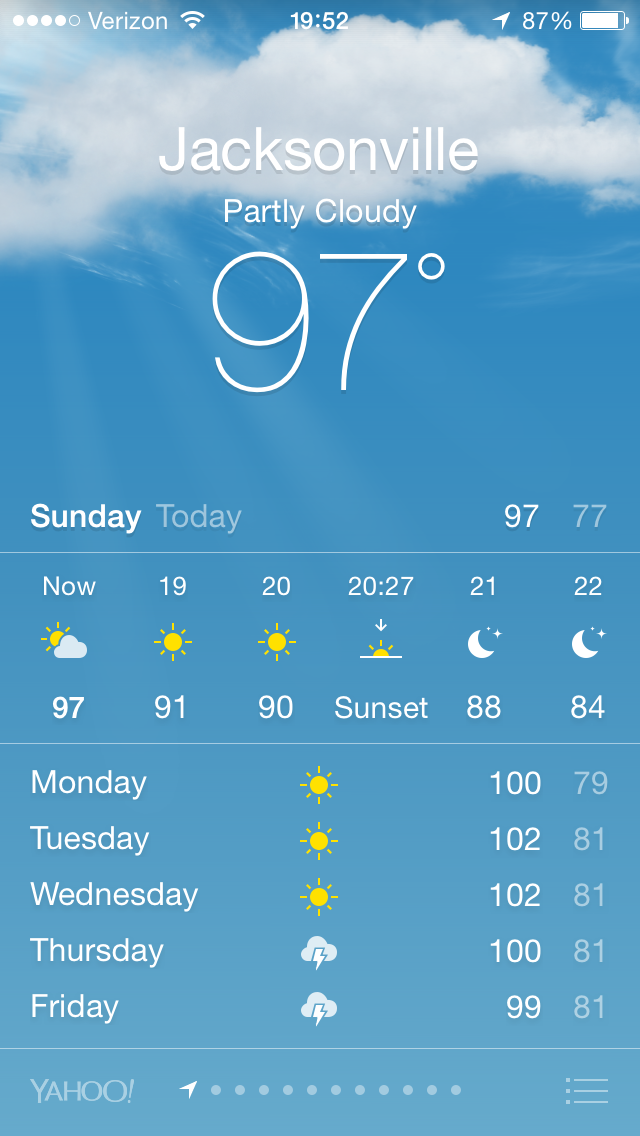
It’s hot. Really hot. As I write this it is 97 degrees here in Jacksonville, though it topped out at 99 when I peeked earlier. It was so hot I didn’t even get this posted until Monday.
The average high temp in June is ‘only’ 90, with the lows usually dipping all the way down to 70. This week, we’ll top 100 most days, and some won’t get out of the 80’s at night.
Last Friday my boss and I went out to find some of our drivers on route and give them a cold Gatorade or water. Those poor guys were melted, and it was ‘only’ 95 that day. We’ll both be going out separately this week doing the same thing. It’s hard to remind our guys if they are breaking a safety rule when it is this oppressively hot, but that’s part of the job as well.
It’s going to be cooler way south in Fort Myers and West Palm this week – what gives?
It’s hot. Really hot. As I write this it is 97 degrees here in Jacksonville, though it topped out at 99 when I peeked earlier. It was so hot I didn’t even get this posted until Monday.
The average high temp in June is ‘only’ 90, with the lows usually dipping all the way down to 70. This week, we’ll top 100 most days, and some won’t get out of the 80’s at night.
Last Friday my boss and I went out to find some of our drivers on route and give them a cold Gatorade or water. Those poor guys were melted, and it was ‘only’ 95 that day. We’ll both be going out separately this week doing the same thing. It’s hard to remind our guys if they are breaking a safety rule when it is this oppressively hot, but that’s part of the job as well.
It’s going to be cooler way south in Fort Myers and West Palm this week – what gives?
Sunday, June 7, 2015
Lawns and Grass
Lawns in Florida are weird. Everyone has this weird grass that looks suspiciously close to what we called "crabgrass' back home. It has these fat 'vine' runners which will cover your driveway of you don't have a bladed edger. See the ads for weed whips which can pivot and edge your lawn? Not against this 'grass.'
Grasses grown in Florida are maintained in a totally different way from those grown in the northern regions of the United States. Northern-grown grasses (e.g., fescue, bluegrass, ryegrass) will grow in Florida only during fall, winter, and early spring months, and will not survive year-round.
Most southern lawn grasses have a coarser leaf texture than those grown further north, especially Florida's three most-used lawn grasses: bahiagrass, St. Augustine grass, and centipede grass. I think I have centipede grass, though it seems even St. Augustine grass has the vine-y runners.
From a lawn & garden maintenance company:'Improved Bermudagrass is a high maintenance turf, due to the requirements and amount of care needed for it be at its best. When used as a home lawngrass, it is recommended having a professional lawn care company to maintain it properly. When maintained correctly it is a beautiful turfgrass, homeowners use it for that “golf course look”.'
You don't want to lie down on this grass - not only are there fire ants and other nasties, but the grass is rough and sometimes even sharp. Not fun. The only 'plus' is that while up north folks don't need to mow since the grass is under snow, you also don't mow in the 'winter' in north Florida because that's the 'dry' season and the grass goes dormant. In the summer, sometimes mowing weekly does not keep up with some of the weeds. Especially in spring, they pop up and send flowers shooting up knee-high even while the grass is just waking up.
Oh well, at least we 'do' have a dormant season, unlike the lawns in south Florida.
Grasses grown in Florida are maintained in a totally different way from those grown in the northern regions of the United States. Northern-grown grasses (e.g., fescue, bluegrass, ryegrass) will grow in Florida only during fall, winter, and early spring months, and will not survive year-round.
Most southern lawn grasses have a coarser leaf texture than those grown further north, especially Florida's three most-used lawn grasses: bahiagrass, St. Augustine grass, and centipede grass. I think I have centipede grass, though it seems even St. Augustine grass has the vine-y runners.
From a lawn & garden maintenance company:'Improved Bermudagrass is a high maintenance turf, due to the requirements and amount of care needed for it be at its best. When used as a home lawngrass, it is recommended having a professional lawn care company to maintain it properly. When maintained correctly it is a beautiful turfgrass, homeowners use it for that “golf course look”.'
You don't want to lie down on this grass - not only are there fire ants and other nasties, but the grass is rough and sometimes even sharp. Not fun. The only 'plus' is that while up north folks don't need to mow since the grass is under snow, you also don't mow in the 'winter' in north Florida because that's the 'dry' season and the grass goes dormant. In the summer, sometimes mowing weekly does not keep up with some of the weeds. Especially in spring, they pop up and send flowers shooting up knee-high even while the grass is just waking up.
Oh well, at least we 'do' have a dormant season, unlike the lawns in south Florida.
Subscribe to:
Posts (Atom)